

Nonprofits and Their Impact in Cochise County Communities
Nonprofit organizations are the quiet architects of American community life, shaping the social, economic, and cultural fabric of the nation. While their contributions often receive less attention than government programs or private enterprise, nonprofits fulfill essential roles in addressing unmet needs and advancing the common good. From food banks and health clinics to arts councils and educational foundations, these organizations provide critical services, foster resilience, and strengthen civic life.
Far from being solely charitable endeavors, nonprofits are vital drivers of community development and economic growth. They fill service gaps left by the public and private sectors, respond swiftly to crises, and build long-term solutions in areas such as healthcare, housing, education, and workforce development. Their presence is especially critical in rural and underserved regions, where access to resources is limited and nonprofits may represent the primary source of social support. In places like Cochise County, Arizona, they function simultaneously as service providers, employers, and advocates for systemic change.
As the nation confronts challenges such as economic inequality, public health crises, climate change, and social justice concerns, nonprofits are increasingly recognized as vital partners in crafting innovative, community-based solutions. They mobilize volunteers, leverage local knowledge, and build trust within communities, allowing them to address both immediate needs and broader structural issues. Beyond service delivery, they generate jobs, stimulate local economies, and foster civic participation.
This article examines the multifaceted role of nonprofits in shaping community well-being. It highlights their economic contributions, influence on public policy, and capacity to advance social transformation—drawing on national data as well as regional insights from Arizona and Cochise County.
Shaping communities
Nonprofit organizations form the backbone of local vitality, offering services that touch nearly every American. While some—such as nonprofit hospitals or food banks—are highly visible, many operate more quietly. Programs in adult literacy, financial literacy, or job readiness, for example, may not capture headlines but are transformative in breaking cycles of poverty and reducing reliance on public assistance
Nonprofits frequently step in where government or for-profit enterprises cannot, particularly in times of crisis. After natural disasters, for instance, they deliver critical services ranging from food distribution and housing support to mental health counseling and virtual education programs (National Council of Nonprofits, 2019). These interventions not only met urgent needs but also strengthened long-term community resilience
Types of 501(c)(3)s Registered with the IRS
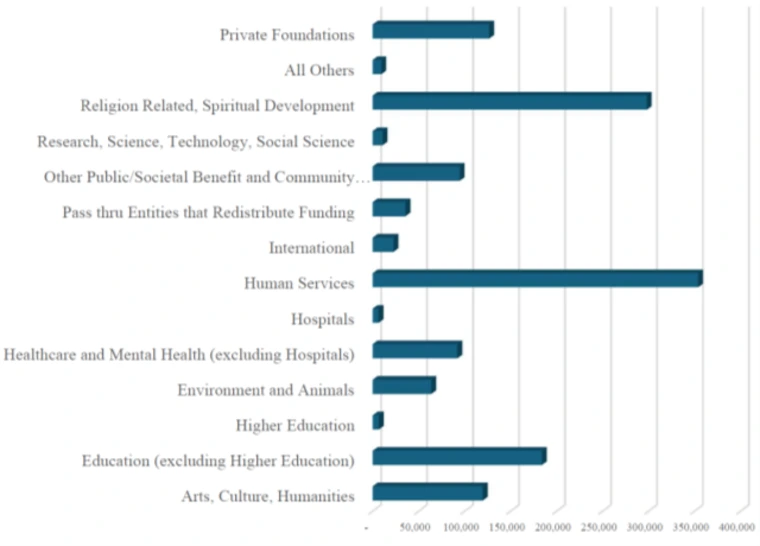
National Council of Nonprofits, 2019
Nationwide economic impact
The nonprofit sector is also a major economic force. As of 2022, nonprofits employed 12.8 million people—approximately 10% of the private workforce—while generating $873 billion in wages and benefits that flow back into local economies through spending, taxes, and charitable giving (U.S. Department of Labor, 2024). Collectively, they spent over $1.5 trillion annually on goods and services to support their programs (Moraczewski, 2023). This demand stimulates a range of industries including IT, real estate, hospitality, and transportation.
Beyond employment, nonprofits serve as catalysts for workforce development by offering training, mentorship, and childcare services that help individuals enter or re-enter the job market. Many collaborate with local governments and employers to design region-specific training programs that address unemployment and skill gaps (National Council of Nonprofits, 2019).
U.S. Nonprofits Ranked by Annual Expenditure

National Council of Nonprofits, 2019
Economic impact in Arizona and Cochise County
Arizona’s nonprofit sector mirrors the national trend, fueling job growth and community investment. The state is home to more than 3,300 nonprofit establishments employing over 222,000 individuals. These jobs generate more than $14 billion in annual wages—accounting for 7.3% of all wages in the state. In total, Arizona nonprofits contribute approximately $58.2 billion in annual spending (Arizona State University, 2025).
In Cochise County, seventy-three nonprofit organizations employ more than 2,000 residents, most of whom work in healthcare. While median earnings hover around $10,000 annually, these wages largely remain in the local economy, reinforcing community stability. Nonprofit spending in the county is estimated at $400 million each year, underscoring their role as both economic drivers and service providers (Office of Economic Opportunity, 2024).
Economic Impact of Arizona Nonprofits in 2025

Arizona State University, 2025
Nonprofit's Share of Arizona State Wages in 2025

Arizona State University, 2025
Cochise County Nonprofit Impact in 2024

Office of Economic Opportunity, 2024
Distribution of Jobs by Sector for Cochise County

Office of Economic Opportunity, 2024
Beyond economics, nonprofits are central to community identity and quality of life. Cultural institutions such as museums, theaters, and arts councils foster civic pride, attract tourism, and encourage business investment. A thriving local arts scene has a multiplier effect: a single theater production can generate revenue for restaurants, shops, and parking facilities, while boosting tax receipts (National Council of Nonprofits, 2019).
Healthcare nonprofits are equally vital. Nearly 58% of U.S. community hospitals are nonprofit-operated, and these institutions reinvest surplus revenue into community benefit initiatives such as free clinics, research, and outreach programs (Manifezt Foundation, 2018). Educational nonprofits also play a crucial role by offering tutoring, scholarships, and enrichment programs that address disparities and improve long-term academic outcomes.
Many nonprofits are mission-driven toward advancing social justice and equity. They provide services to marginalized groups, including the homeless, immigrants, survivors of domestic violence, and formerly incarcerated individuals. Their interventions address both immediate needs and root causes of inequality
For instance, housing nonprofits not only develop affordable units but also offer rent relief and case management to prevent homelessness, thereby reducing strain on emergency services. Reentry programs help formerly incarcerated individuals secure employment and housing, lowering recidivism rates and promoting community stability.
Policy advocacy and civic engagement
In addition to service provision, nonprofits influence systemic change through policy advocacy. They conduct research, organize communities, and lobby lawmakers on issues ranging from environmental sustainability to healthcare access and civil rights. Their grassroots mobilization ensures that diverse voices are represented in policymaking processes.
Nonprofits also foster civic engagement through voter registration, public forums, and educational campaigns, helping strengthen democracy and empower politically marginalized populations.
Long-term community development
The most effective nonprofits balance immediate service delivery with long-term planning. Guided by community input and rooted in local contexts, they expand services, replicate successful models, and collaborate across sectors to tackle complex challenges. As Elefante (2012) observed in relation to historic preservation, “The greenest building is the one that is already built.” Similarly, the most impactful solutions often emerge from organizations already embedded in their communities. With adequate support, these nonprofits can innovate, scale, and drive sustainable development.
Conclusion
Nonprofits are indispensable pillars of American life. They strengthen communities through healthcare, education, arts, and social services while fueling economic growth and advancing equity. Their ability to bridge service gaps, respond to crises, and empower citizens underscores their vital role in building more resilient and inclusive communities.
Sustained investment in the nonprofit sector is not just beneficial but essential. By recognizing and supporting the diverse contributions of nonprofits, policymakers, funders, and citizens can help ensure that communities across the nation continue to thrive.
References
Arizona State University Lodestar Center for Philanthropy and Nonprofit Innovation. (2022). Nonprofit workforce dashboard. https://bi.arizona.edu/t/ASU/views/NonprofitWorkforceWP/Dashboard1
Arizona State University Lodestar Center for Philanthropy and Nonprofit Innovation. (2025). Nonprofits: A hidden driver of Arizona employment. https://lodestar.asu.edu/research/scope
Camper, N. (2016, March 25). Why is a strong nonprofit sector key to thriving communities? Forbes. https://www.forbes.com/sites/jpmorganchase/2016/03/25/why-is-a-strong-nonprofit-sector-key-to-thrivingcommunities/
Elefante, C. (2012). The greenest building is... one that is already built. Forum Journal, 27(1), 62–72. https://doi.org/10.1353/fmj.2012.a494514
Manifezt Foundation. (2018, July 10). So how do nonprofit organizations benefit our society? https://www.manifezt.org/so-how-do-nonprofit-organizationbenefit-our-society/
Moraczewski, E. (2023, March 21). The economic importance of nonprofits. NMBL Strategies. https://www.nmblstrategies.com/blog/the-economicimportance-of-nonprofits
National Council of Nonprofits. (2019). Nonprofit impact in communities. https://www.councilofnonprofits.org/about-americas-nonprofits/nonprofit-impactcommunities
Nonprofit News Feed. (2024). Why nonprofits matter to the economy in 5 key stats. https://nonprofitnewsfeed.com/resource/why-nonprofits-matter-to-theeconomy-in-5-key-stats/
Office of Economic Opportunity. (2024). Cochise, Greenlee, and Graham Counties – Arizona. https://oeo.az.gov/labor-market/data-access
U.S. Bureau of Labor Statistics. (2022). Business employment dynamics. https://www.bls.gov/bdm/nonprofits/nonprofits.htm
U.S. Department of Labor, Bureau of Labor Statistics. (2024). 2022 annual averages–Private nonprofit establishment data.