

Project CENTRL equips leaders to help rural communities thrive
More than 750 people have attended the yearlong Cooperative Extension leadership development program.
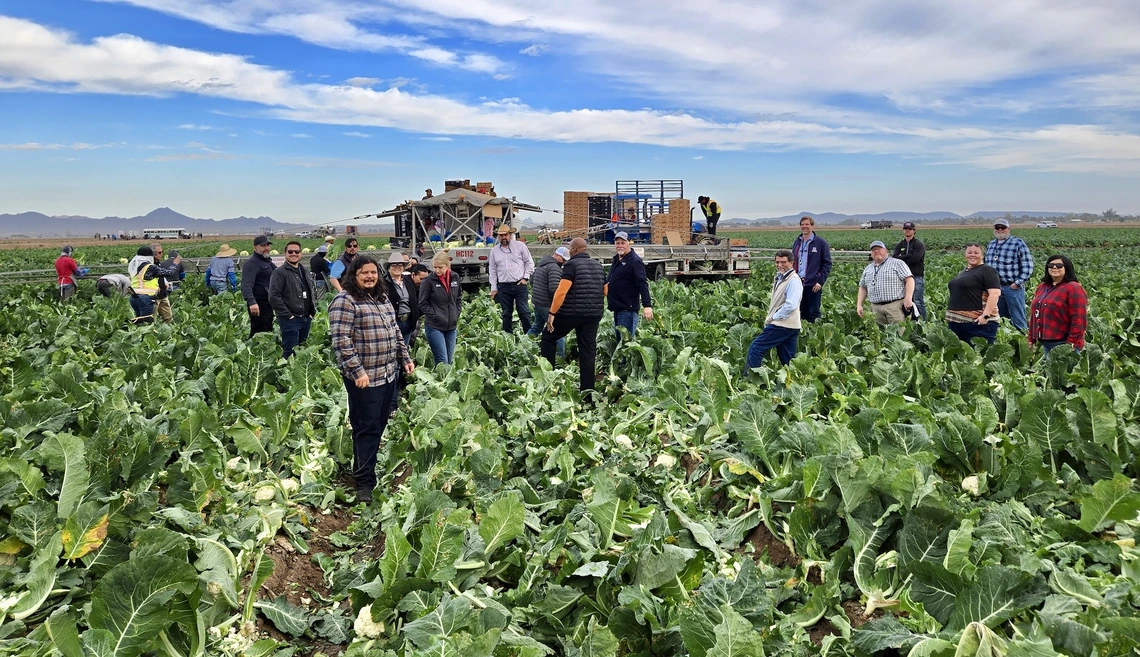
Project CENTRL is a hands-on leadership development program that takes participants out into the real world, in this case a farm field in Yuma.
For 43 years, University of Arizona Cooperative Extension’s Project CENTRL has been quietly building a network of leaders who get things done.
More than 750 people have gone through the yearlong leadership development program, which brings together people from all walks of life to strengthen rural communities and amplify their voices across the state.
“It really gave me a nice perspective, zoomed out away from my little niche in agriculture,” said Stephanie Teskey, a sixth-generation cattle rancher from Dugas, Arizona, who went through the program in 2018.
“What I was able to learn from my classmates, those relationships, unconsciously built that zoomed-out view, being able to see how different things are connected across different industries,” Teskey said.
Born of collaboration
Project CENTRL started in 1981 after Farm Bureau Executive Secretary Andy Kurtz met with College of Agriculture leaders to explore ideas for bolstering rural leadership. The first class started in October 1983, and the 34th class graduated in June.
Currently the program includes nine multi-day meetings in Arizona, Washington, D.C. and Sonora, Mexico. Topics for these seminars include leadership fundamentals, communication, natural resources and the rural economy, state budget, agriculture on the border and public policy in Arizona and Washington, D.C.
The goal is simple – to equip and empower leaders to meet the needs of rural Arizona so those areas can remain healthy, vibrant and sustainable. The focus is on active mentoring and collaboration.
Alumni amplify rural voices, including in urban areas where they sometimes struggle to be heard. Part of the mission is to “shrink” the state by bringing rural and urban communities together, said Executive Director Scott Koenig.
Each annual class brings together people from a variety of backgrounds and ages to spur discussion, Koenig said.
“We select people who we know are going to be different and have different opinions, different backgrounds and different strengths,” he said.
That broad spectrum of graduates is perhaps Project CENTRL’s greatest strength, said university Associate Vice-President Ed Martin, Arizona Cooperative Extension’s state director.
“The program brings together individuals from diverse backgrounds, industries and regions of Arizona. Participants leave with lifelong relationships and a statewide network they can call upon to solve problems, share ideas and support one another. In an increasingly complex world, those relationships are among the program's greatest strengths,” Martin said.
Project CENTRL is one program of the Arizona Center for Rural leadership, which also includes Alumni in Action, the center’s network of Project CENTRL alumni, and Make a Difference projects that identify rural needs and gather teams to effect change.
The Miami Veterans Memorial Wall started with Project CENTRL, as did the relocation of the Pima County Cooperative Extension office to the Campus Agricultural Center, Koenig said.
Diverse alumni
Graduates include Paul Brierley and Brett Cameron, current director and retired assistant director of the Arizona Department of Agriculture, and Santana Nez-Coleman, a Diné rancher who holds a doctorate in veterinary medicine from the College of Veterinary Medicine. Koenig is an alum, as are four current state legislators.
Candidates are generally looking for three things – self-improvement, giving back to their communities and professional development. People seeking just one or two of these generally don’t make it through, Koenig said.
The program is modeled after previous work in Michigan, Pennsylvania, California and Montana. Arizona’s program is unique in that it focuses specifically on rural communities and not just agriculture in general.
“Our philosophy has always been that if you’re agriculture, you’re affecting rural Arizona, and if you’re in rural Arizona, you’re affected by agriculture,” Koenig said.
Project CENTRL is tuition-free despite investing roughly $30,000 per participant. Similar programs can cost $5,000, he said.
Driven by community needs
The program doesn’t pick challenges, such as water issues or education, then ask graduates to fan out across Arizona to solve them. Like all Cooperative Extension programs, it’s driven by community needs, Koenig said.
“I think the most meaningful change happens when I, as an individual, find a need in my community, and I have a passion for it. It has to be that marriage between need in the community and personal skills and passion. We want everybody to go out and find that,” he said.
Graduates return to their communities with stronger leadership skills, a better understanding of Arizona's opportunities and challenges and an expanded network of potential partners committed to making a difference, Martin said.
“These relationships often lead to collaborations that cross county lines, industries and political perspectives, leading solutions that no single organization or community could achieve alone,” he said.
The hands-on experiences have opened participants’ eyes to commonalities among rural and urban communities. That was illustrated by an interaction during one of Project CENTRL’s seminars, Koenig said.
“Somebody who was on a school board in a Phoenix metro area, after we were done at a ranch in Eager and driving back to Show Low on the bus, he said, ‘These issues that sound like rural issues, they sound exactly the same as the school board issues that we talk about,’” he said.
Graduates get involved
Teskey is a good example of how Project CENTRL alumni get involved. She is a former northern lieutenant for the Arizona Department of Agriculture who now works for livestock management software company AgriWebb.
She has been on the Arizona Cattle Growers Association Executive Committee for the past four years and is a former board member for the Yavapai Cattle Growers Association. She was recently appointed as the cattle industry representative on the Arizona Veterinary Medical Examining Board.
She came to Project CENTRL early in her career, she said.
“I was very passionate about agriculture and wanted to be more involved, so I had all of the ambition, but maybe not as much confidence as I needed to actually pursue that,” she said.
Project CENTRL proved to be a turning point that helped Teskey realize that leaders are just skilled people who stepped up where and when they had chances. The program gave her the confidence to do that, she said.
“Nobody asks you to be in a leadership role. It's something that you step up and volunteer for. The world is run by people who show up,” she said.
Martin agreed.
“Leadership is not about titles or positions. It’s about the willingness to serve, the courage to make difficult decisions and the commitment to leave your community better than you found it. Project CENTRL has helped develop exactly that kind of leadership,” he said.
To find out more about Project CENTRL, see the Arizona Center for Rural Leadership website.