

Extension agronomist's science helps growers prosper
Bhupinder Singh grew up in the agricultural Punjab region in India. Later he earned advanced degrees and brought his expertise to Arizona Cooperative Extension in 2024.
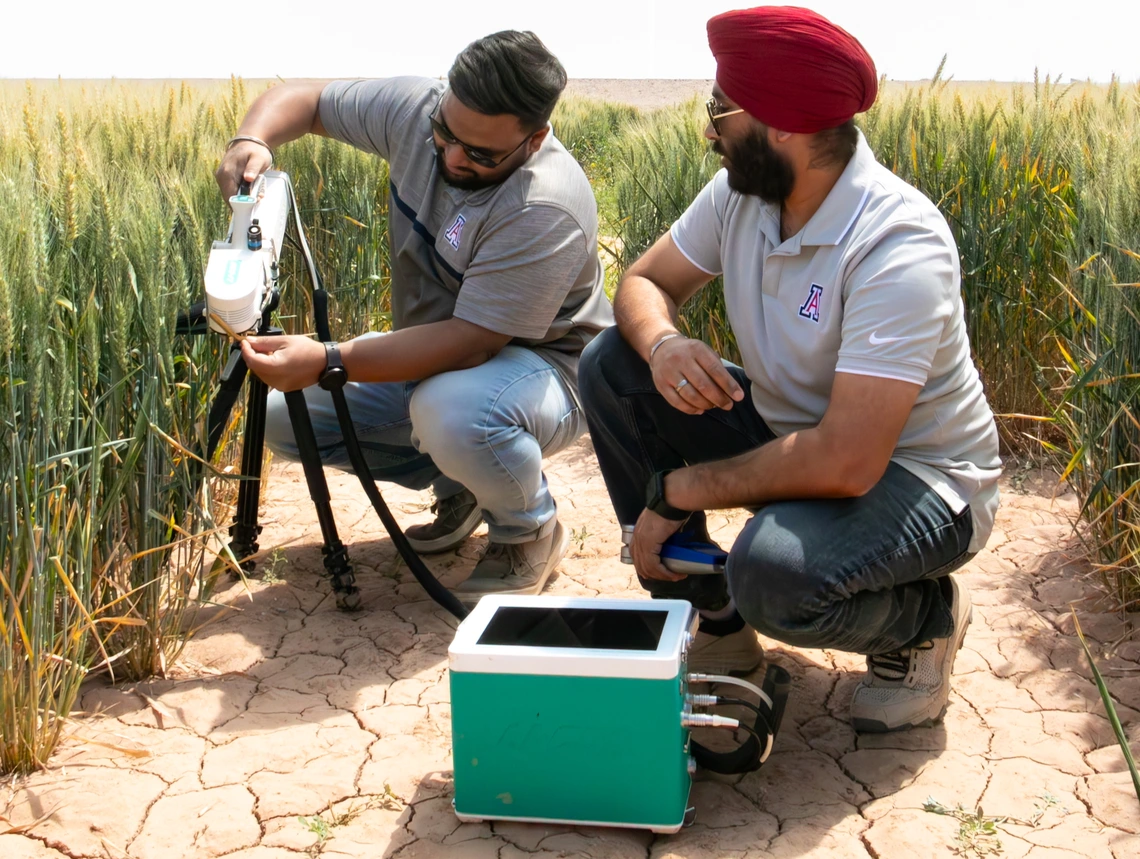
University of Arizona Cooperative Extension agronomy research helps commercial growers decide which varieties are best suited for our arid, hot environment.
Luis Zozaya, ALVSCE
Agriculture is at the heart of Arizona's economy and culture, and Cooperative Extension science has been a guiding force for commercial growers across the state for more than a century. Our research is directly tied to real-world problems. We listen to growers, help them identify needs, then design our research around meeting those needs. Bhupinder Singh came to Cooperative Extension last year to help. Growing up on a farm in Punjab region of India gave Singh a deep dedication to agriculture generally and crop science specifically. He eventually earned a bachelor’s degree in agricultural sciences at Punjab Agricultural University and later a master's and Ph.D. in agronomy (crop physiology) from Mississippi State University.
What is agronomy, and why is it important in Arizona?
Agronomy is the science of soil management and crop production. It is vital for investigating the interactions among crops, management and environment to maximize crop productivity while minimizing environmental pollution. Arizona crop production faces significant challenges from both biological and other stresses in our arid, hot environment.

Bhupinder Singh
Cooperative Extension
The primary non-biological challenges in Arizona are high temperatures, water scarcity and soil salinity. The extreme heat, with more days exceeding optimal growing temperatures, directly affects growth, reduces photosynthesis, impairs plant reproduction and can significantly lower crop yields and quality. High temperatures have also triggered water supply cuts due to increased evapotranspiration, exacerbating drought conditions. High evaporation rates compound these problems, leading to the accumulation of salts at the soil surface, causing stress and toxicity in plants.
Biological stress, including pests, diseases and weeds, also causes significant yield loss in Arizona crops. It becomes more problematic when crops are already weakened by non-biological stress. Studying the impact of stress on crop health begins with understanding how crops respond to ecological stresses.
Given all these factors, agronomy can help Arizona growers sustain crop health and production. My research and Extension in Arizona provides deeper understanding of genetic, physiological and biochemical mechanisms to develop crops with enhanced stress resilience and yield potential.
What are some things you have researched or are working on now, and why have you chosen to study the things you study?
Since coming to Extension in August 2024, I have focused on generating applied research-driven knowledge to educate my stakeholders, primarily commercial producers. Through collaboration with growers and the industry on experimental trials, my program conducts research and outreach demonstrations and facilitates hands-on learning. This is an essential part of creating cropping system awareness and sharing fundamental and applied knowledge with commercial agricultural producers in Arizona and other arid and semi-arid environments, combating ecological stresses.
I conducted a Statewide Agronomy Needs Assessment Survey by meeting with a diverse range of stakeholders. I identified region-specific crops grown by farmers across the state and the challenges they face in their production. I identified the top three challenges faced by growers in crop production in Arizona, resulting in significant loss of agricultural economy, as follows: 1) Variety selection, 2) Weather variability, and 3) Pest management.
To address these issues, I first communicated with existing specialists and reviewed the literature on agronomic research on cropping systems in the past. This helps me understand that most of the applied research in cropping systems was more than a decade old. Most of the work has been done on old cultivars and under historic ecological conditions. The farmers could no longer apply information from past agronomic work to address challenges in selecting present germplasm, as well as management practices to mitigate the impact of present non-biological and biological stresses.
Every year, new cultivars are released in the market. Growers are always seeking answers to what cultivars are most adaptable to their environments and which management practices are most suitable to adopt, to optimize the use and rate of inputs, minimize the impact of stresses and maximize the return on their existing cropping system. Keeping this in mind, my applied research work consisted of three main programs: 1) Statewide variety testing trials, 2) Weed management and crop safety trials, and 3) Best management practices trials.
How is changing climate affecting your area of expertise, and how can your work in Cooperative Extension help prepare Arizona growers for a drier, warmer future?
My program is committed to identifying best management practices that prioritize heat tolerance and effective irrigation strategies. I utilize advanced plant phenotyping tools and innovative crop modeling approaches to develop resilient crop production systems explicitly tailored for desert ecosystems. Plant phenotyping tools are critical for accurately assessing crop performance and reinforcing best management practices in agriculture. These phenotyping tools measure a wide range of plant traits, morphological, physiological and biochemical, that are directly linked to productivity, stress tolerance, and resource-use efficiency. By integrating these powerful tools with best management practices, we can optimize input use, enhance yields and promote sustainability.
Furthermore, I employ crop models to explore and test cutting-edge strategies for irrigation, fertilization and crop selection under projected changes climates for Arizona. This approach leads to increased productivity, reduced environmental impact, and heightened resilience to future climate conditions.
I recently published an Extension paper that provides an objective summary of projected temperature increase across the cotton belt region of the United States.
By simulating the intricate interactions between crops, soil and the environment, crop models offer invaluable insights for sustainable agriculture on a broader scale. My trials rigorously assess management practices, technologies and plant responses under both real and simulated stress conditions, ultimately driving improvements in productivity, water-use efficiency and thermal tolerance within Arizona cropping systems.
Check our Bhupinder Singh's work on his lab website.